
AQL Calculator by Vietnam Inspections
A Comprehensive Guide to Reading and Using the AQL Table for Quality Inspection
In international trade and manufacturing, AQL (Acceptable Quality Limit) is the global gold standard for measuring the quality of a shipment. At Vietnaminspections, we strictly adhere to the international ISO 2859-1 (ANSI/ASQ Z1.4) standard to ensure every evaluation is objective, transparent, and highly accurate.
If you are an importer, buyer, or supply chain manager, understanding how the AQL table works is essential for managing your product quality. Below is a step-by-step guide from our inspection experts.
How Does the AQL Table Work?
The AQL table helps us answer the two most critical questions during an inspection:
-
How many units do I need to inspect (Sample Size) from the total lot?
-
What is the maximum number of defective units allowed for this shipment to “Pass”?
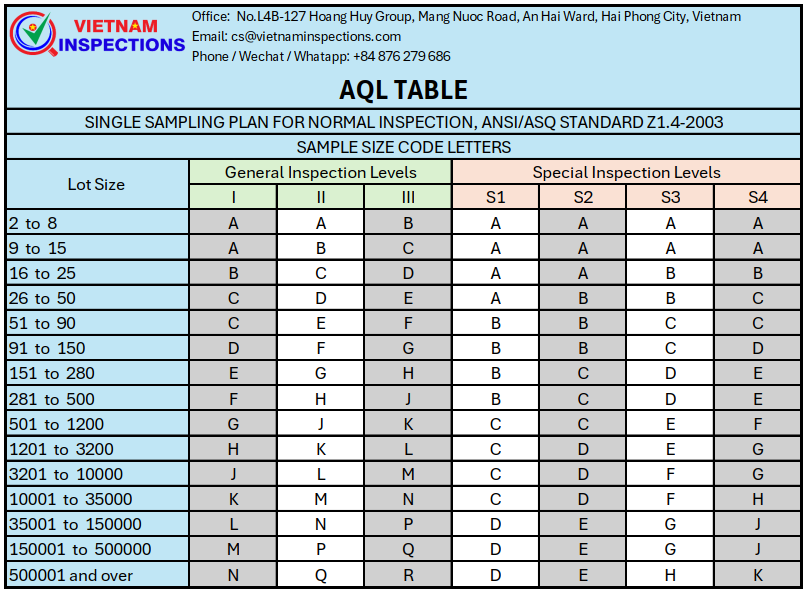
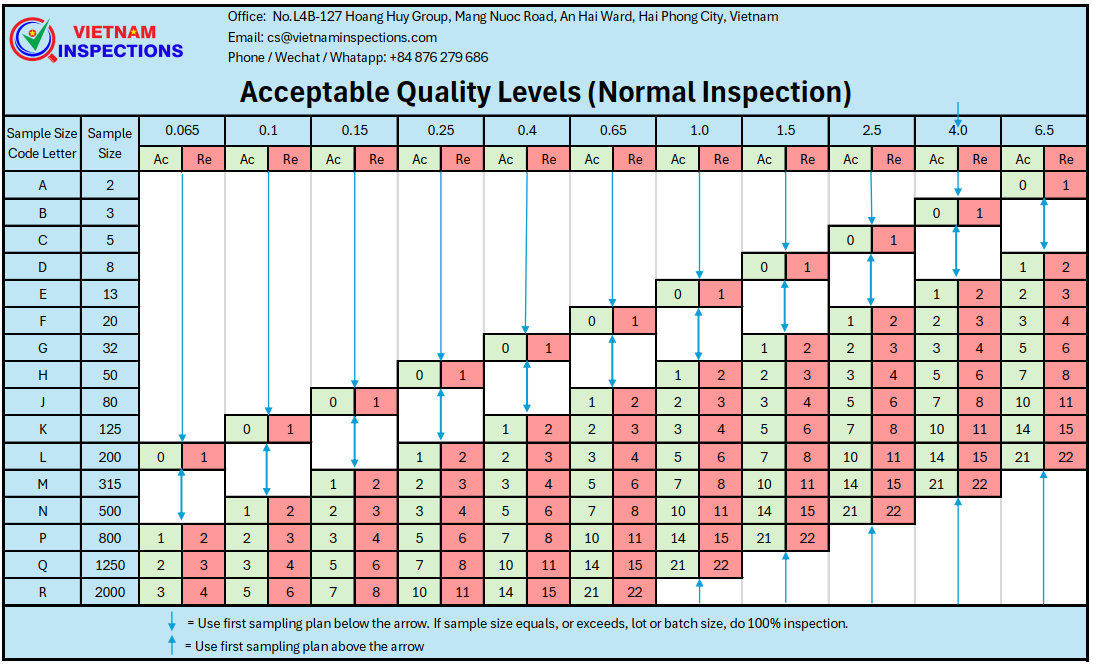
The standard AQL chart consists of two sub-tables: Table 1 (Sample Size Code Letters) used to find your specific code letter, and Table 2 (Single Sampling Plans) used to determine the exact sample size and defect limits.
6 Steps to Using the Standard AQL Table
Step 1: Determine the Lot Size
This is the total quantity of products in your order that are fully produced, packed, and ready for inspection.
-
Example: You placed an order for 5,000 dress shirts.
Step 2: Choose the Inspection Level
Table 1 features Special Inspection Levels (S-1, S-2, S-3, S-4) and General Inspection Levels (I, II, III).
-
In over 90% of consumer goods inspections, General Inspection Level II is used as the default standard because it offers the perfect balance between cost, time, and accuracy.
Step 3: Find the Code Letter (Table 1)
Cross-reference your “Lot Size” row with your “Inspection Level” column on Table 1 to find the intersecting letter.
-
Based on our example: A lot of 5,000 units falls into the “3,201 to 10,000” range. Under General Level II, the intersecting code letter is L.
Step 4: Determine the Sample Size (Table 2)
Move over to Table 2. Locate your code letter in the first column, then look at the adjacent “Sample Size” column to find the exact number of units the inspector needs to pull for checking.
-
Code letter L corresponds to a sample size of 200 units.
Step 5: Define AQL Limits for Each Defect Type
At Vietnaminspections, defects are typically categorized into three types with standard consumer goods AQL levels (these can be customized based on your agreement with the supplier):
-
Critical Defect (AQL 0): The product poses a safety hazard to the user or violates regulations. Zero tolerance; no defects allowed.
-
Major Defect (AQL 2.5): The product is unsalable due to a severe malfunction, damage, or significant deviation from specifications.
-
Minor Defect (AQL 4.0): The product has small cosmetic imperfections that do not affect its function and remain acceptable to most end-users.
Step 6: Find the Acceptance (Ac) and Rejection (Re) Numbers
On Table 2, from your code letter and sample size row (Row L, 200 samples), trace horizontally to the columns corresponding to your chosen AQL levels (0, 2.5, and 4.0). You will find two numbers:
-
Ac (Acceptance): The maximum number of defects allowed for the shipment to Pass.
-
Re (Rejection): If the number of defects reaches this mark, the shipment will Fail.
A Real-World Example from Vietnaminspections
Let’s apply all 6 steps to our order of 5,000 shirts, using Level II, and an AQL of 0 / 2.5 / 4.0. Our inspector will randomly pull 200 shirts from various master cartons across the warehouse.
According to the AQL table, the defect limits are as follows:
-
Critical (AQL 0): Ac = 0, Re = 1. (If even 1 critical defect is found -> The shipment Fails).
-
Major (AQL 2.5): Ac = 10, Re = 11. (Up to 10 major defects are allowed. If 11 major defects are found -> The shipment Fails).
-
Minor (AQL 4.0): Ac = 14, Re = 15. (Up to 14 minor defects are allowed. If 15 minor defects are found -> The shipment Fails).
Important Note Regarding Arrows in Table 2: When tracing across the table, if you encounter an upward or downward-pointing arrow instead of numbers, you must follow the arrow to the first set of Ac/Re numbers you find. Importantly, you must also change your Sample Size to correspond with that new row.
Why Leave This to Vietnaminspections?
Reading the AQL table might seem straightforward in theory, but properly executing random sampling, accurately identifying hidden defects, and strictly classifying them (Critical/Major/Minor) requires years of on-site factory experience.
The expert team at Vietnaminspections is not only proficient in applying AQL standards but also excels at delivering visual, comprehensive reports that give you total control over your shipments—even from thousands of miles away.
Struggling to set the right AQL limits for your specific product category? Contact Vietnaminspections today to get free consultation and secure your next shipment with Vietnam’s leading quality control experts!